More Information
News
Dr. Bashir explains how the Jump simulation center creates physician innovators and inventors
Finalist in the 2014 FDA food safety challenge. One of 5 finalist for a half million price
Prof. Bashir instrumental in the first major gift to new UI med school.
Dr. Bashir Podcast featured on ASME: Engineering Bio-Hybrid Devices
LIBNA graduate students highlight on UIUC graduate college website
AAAS: In Biomedical Engineering, Experts See Big Research Opportunities and Some Funding Challenges
Skeletal Muscle Powered Bio-Bots Featured in Illinois News. Congratulations Caroline and Ritu! Watch Video on YouTube
Maggie Sobieraj chosen as a 2014 recipient for the MCB Summer Undergraduate Research Fellowship
Middle school students in Louisville, KY publish article discussing Bashir group biobots
CD4+/CD8+ T Cell counter featured on cover of Science Translational Medicine
Mayo Clinic and Illinois researchers develop new sensor for methylated DNA:
link 1 | link 2
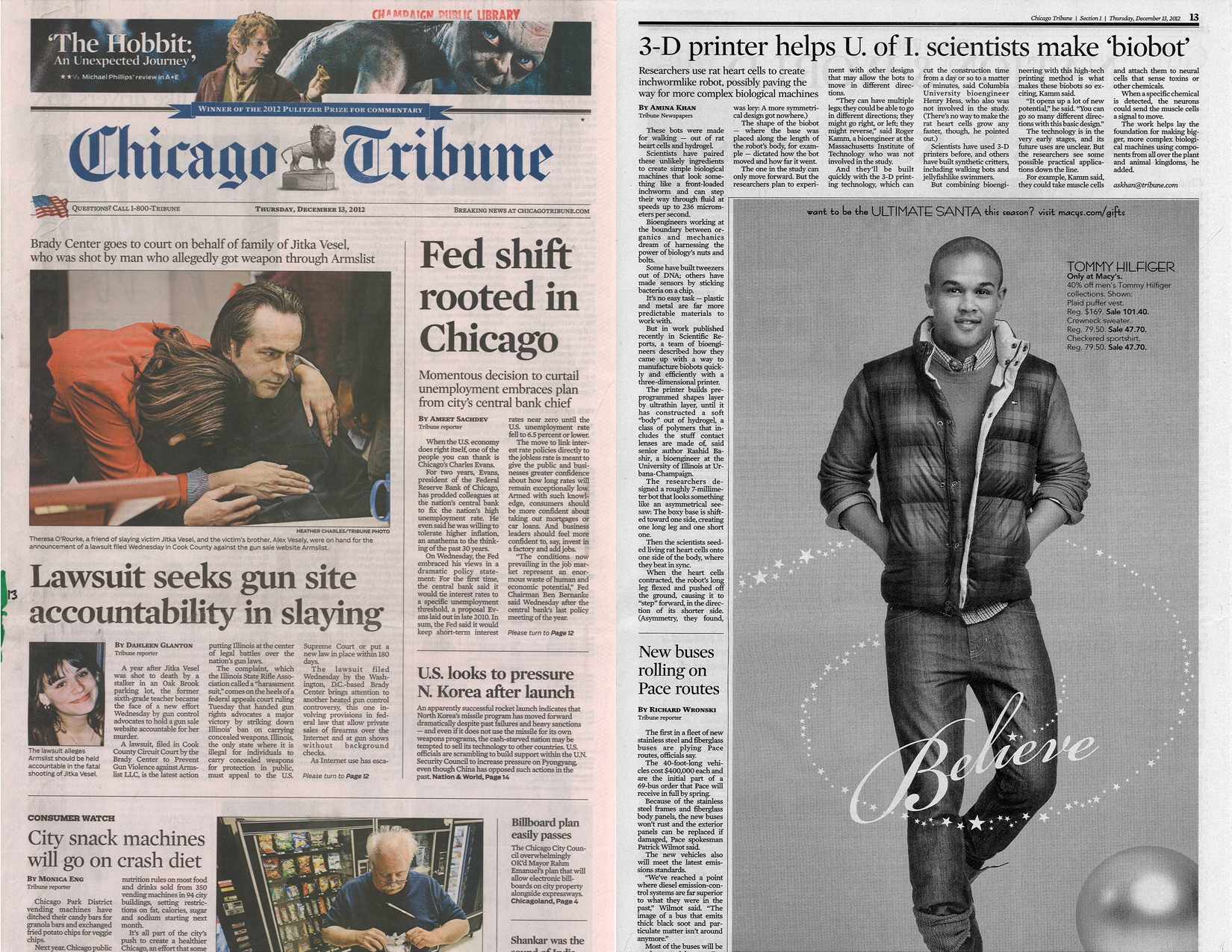
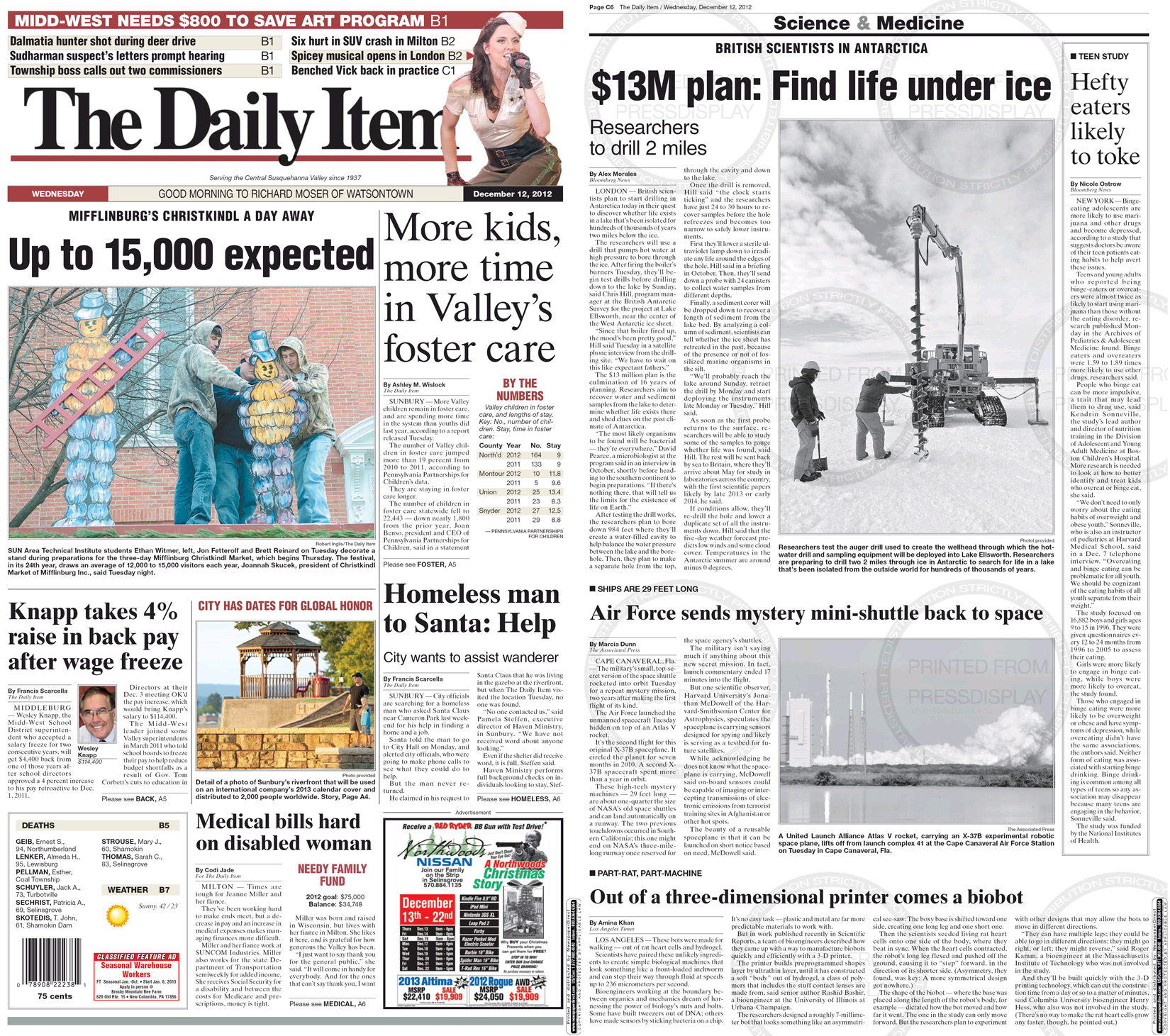
Bio-bots featured in news worldwide!
Online: NBC News | BBC News Tech | CNN Money | Discovery News | National Geographic | Popular Mechanics | Scientific American | The Scientist | Txchnologist by GE | Atlantic Wire | IEEE Spectrum | Illinois News Bureau | NASA Tech Brief
In Print: The Daily Illini | The Chicago Tribune | The Daily Item | The Los Angeles Times |
Also syndicated by the New York Times
Videos: PBS "Chicago Tonight" | Mashable | Engineering Newswire
To appear in: Biofutur (France), Plàstico Industrial (Brazil)

Smart Bandages Grow Blood Vessels feature on InsideScienceTV
High school student Chelsea Edwards works with Bashir lab as part of I-STEM program
Vincent featured in EBICS Experimental methods for Biological Machines video
Watkins develops award-winning product that could improve AIDS treatment
Prof. Bashir co-guest edits the November/December 2011 issue of IEEE Pulse on BioMEMS

Adarsh joins University of Louisiana, Ruston as Assistant Professor
LIBNA Director, students helping to lead Global Health Initiative
April 1, 2011, Vincent Chan one of the winners of poster award in BioE day at UIUC
2011 Bionanotechnology Summer Institute Call for Applications
Microsensors offer first look at whether cell mass affects growth rate
A team University of Illinois researchers led by electrical and computer engineering and bioengineering professor Rashid Bashir have developed an array of microsensors to measure the relationship between cell mass and growth rate.
NIH establishes cancer nanotechnology training center at Illinois
A recently announced grant from the National Institutes of Health will establish a new M-CNTC: Midwest Cancer Nanotechnology Training Center at the University of Illinois at Urbana-Champaign. Funded by the NIH/NCI Alliance for Nanotechnology in Cancer, the M-CNTC will serve as a regional hub, partnering with the Mayo Clinic, University of Illinois at Chicago, Washington University at Saint Louis, and the Indiana University School of Medicine.
New IGERT grant will help train next generation of leaders
The University of Illinois has recently been awarded a five-year, $3.2 million grant from the National Science Foundation’s Integrative Graduate Education and Research Training (IGERT) program aimed at producing the next generation of intellectual leaders who will define the new frontiers of Cellular & Molecular Mechanics and Bio-Nanotechnology (CMMB).
- August 10, 2010
Prof. Bashir is quoted in a Science review article
Who needs labels? Whether based on optical, mechanical, or electrical detection, label-free methods can probe molecular pas de deux in their native, unadulterated states. As a result, they are faster, simpler, and more physiological than their labeled counterparts.
- February 23, 2010
Illinois is a partner in new NSF Center to investigate the creation of biological machines
The National Science Foundation (NSF) has awarded $25 million to establish the Emergent Behaviors of Integrated Cellular Systems (EBICS) Center at the University of Illinois at Urbana-Champaign, the Massachusetts Institute of Technology (MIT), and the Georgia Institute of Technology.more >>
-
June 3, 2009
Aluminum-oxide Nanopore Beats Other Materials For DNA Analysis
Fast and affordable genome sequencing has moved a step closer with a new solid-state nanopore sensor.more >>
-
June 5, 2009
For DNA Analysis, Aluminum-Oxide Nanopore Beats Other Materials
Fast and affordable genome sequencing has moved a step closer with a new solid-state nanopore sensor being developed by researchers at the ...more >>
-
June 25, 2009
Blog. Aluminum Oxide Nanopore for DNA analysis
University of Illinois at Urbana-Champaign researchers are developing a new solid-state nanopore sensor that they believe can move the ...more >>
-
June 2, 2009
Aluminum-oxide nanopore beats other materials for DNA analysis
The nanopore sensor, made by drilling a tiny hole through a thin film of aluminum oxide, could ultimately prove capable of performing DNA ...more >>
-
June 3, 2009
Aluminum-oxide nanopore beats other materials for DNA analysis - R & D
Unlike both its biological and silicon-based counterparts, the aluminum-oxide nanopore sensor built using atomic layer deposition at the Univ. of Illinois ... more >>
-
May 15, 2009
Aluminum-oxide Nanopore Benefits - Nanotechnology.
Aluminum-oxide nanopore benefits - Fast and affordable genome sequencing has moved a step closer with a new solid-state nanopore sensor ... more >>
-
June 3, 2009
Aluminum-oxide Nanopore Beats Other Materials For DNA Analysis.
The nanopore sensor, made by drilling a tiny hole through a thin film of aluminum oxide, could ultimately prove capable of performing DNA ... more >>
-
June 17, 2008
A new array of microfabricated silicon cantilevers gives researchers a way to track the growth of individual adherent cells.more >>
-
June 11, 2008
Living cantilever arrays for characterization of mass of single live cells in fluids
How much does a cell weigh? US chemists are using miniature cantilevers to find out. 'Cell mass is directly related to cell growth and division,' says Rashid Bashir at the University of Illinois at Urbana-Champaign. In an effort to understand the role a cell's mass plays in these processes, Bashir and colleagues have designed a device to measure an individual cell's mass as it grows in fluid. more >>
-
June 13, 2007
Bacteria ferry nanoparticles into cells for early diagnosis, treatment
Researchers at Purdue University have shown that common bacteria can deliver a valuable cargo of "smart nanoparticles" into a cell to precisely position sensors, drugs or DNA for the early diagnosis and treatment of various diseases. more >>
-
April 5, 2007
Purdue researchers use 'nanopore channels' to precisely detect DNA
Researchers at Purdue's Birck Nanotechnology Center have shown how "nanopore channels" can be used to rapidly and precisely detect specific sequences of DNA as a potential tool for genomic applications in medicine, environmental monitoring and homeland security. more >>
-
September 6, 2006
Nanoscale cantilevers behave anomalously
Normally a cantilever's resonant frequency decreases when molecules attach to it – a finding that is the basis of nanomechanical sensing devices. But now researchers from Purdue University, US, have found that the resonant frequency of some nanoscale cantilevers may actually increase on the addition of molecules. more >>
-
August 28, 2006
'Nanocantilevers' yield surprises critical for designing new detectors
Researchers at Purdue University have made a discovery about the behavior of tiny structures called nanocantilevers that could be crucial in designing a new class of ultra-small sensors for detecting viruses, bacteria and other pathogens. more >>
-
2005 Best of Small Tech Awards
Prof Bashir nominated as one of 5 finalists in "Small Times Magazine Innovator of the Year 2005"
- http://www.eet.com/story/OEG20000711S0023
- http://news.uns.purdue.edu/html4ever/010907.Nano.bullets.html
- Photonics Spectra Article
- Natural Materials Highlights on Swell Sensors
- Bay Area Talk
- National Academy of Engineering FOE Meeting in Sept 2003
- Global Indus Technovators Awards.htm
- http://timesofindia.indiatimes.com/articleshow/325307.cms
- Bacterial Detection in Nanobiotech News
- Cantilever Sensors for Virus Detection in Nanobiotech News
- http://www.nature.com/nsu/040209/040209-4.html
- http://www.indolink.com/SciTech/fr020904-074024.php
- http://www.eetimes.com/story/OEG20040213S0009
- http://www.popsci.com/popsci/medicine/article/0,12543,639003,00.html
- http://www.memagazine.org/contents/current/features/nanofire/nanofire.html
- http://www.sciencedaily.com/releases/2004/02/040210081727.htm
- Our research featured on CNBC. (movie)
- Our Lab members in action. (movie)
- Our work on NCI Nanocenter Website. -(downlooad pdf)
- Nanobiotech news about Oncological Sciences at Purdue. -(downlooad pdf)